



Pluggnb is not a genre you can fake with one bell preset and a Roland TR-808.
That may sound harsh, but producers already know it is true. The sound’s surface is easy to copy: dreamy keys, soft bells, emotional chords, sliding 808s, open drums, Auto-Tuned vocals, late-night atmosphere. The deeper part is harder. Pluggnb works when the producer understands mood, space, bounce, melody, and emotional restraint.
That is why tools matter, but only up to a point.
A good plugin will not save a boring melody. A sample pack will not give you a taste. A vocal preset will not make an artist believable. But the right tools can help a producer move faster, find better textures, shape the low end, polish the vocal, and finish songs without killing the feeling that made the beat work in the first place. Thanks to technology, fantastic tools are available today and relatively cheap. When I think of tracker software and 8-bit samples from the late ‘80s and early ‘90s, and expensive hardware in that time, I feel like today’s music producers are blessed with outstanding, high-quality software that costs a few hundred dollars.
This guide is not a shopping list masquerading as music criticism. It is a producer-focused breakdown of the tool categories that actually make sense for pluggnb: melody sources, sample libraries, 808s, vocal tools, mix plugins, release workflow, and a few brands worth checking out if you want to build the sound seriously.
Pluggnb Explained: The Sound, Producers, Artists, and Beat Economy Behind the Genre
Table of Contents
- Start With the Formula: Melody, Bounce, Space, and Feeling
- Melody Sources: Keys, Bells, Pads, Plucks, and Emotional Chords
- Sample Libraries and Loops: Useful, but Dangerous
- 808s and Bass Tools: The Low End Should Move, Not Bully the Beat
- Drum Sounds: Keep the Pocket Relaxed but Alive
- Vocal Tools: Pluggnb Needs Emotion, Not Just Auto-Tune
- Mixing Tools: Space Is the Sound
- Release and Distribution: When the Beat Becomes a Song
- Pluggnb Producer Toolkit: A Practical Setup
- What Not to Buy Yet
- To Remember: The Tool Is Not the Identity
Start With the Formula: Melody, Bounce, Space, and Feeling
Before talking about plugins, it helps to remember what pluggnb is built on.
The core formula is simple: melody, bounce, space, and feeling.
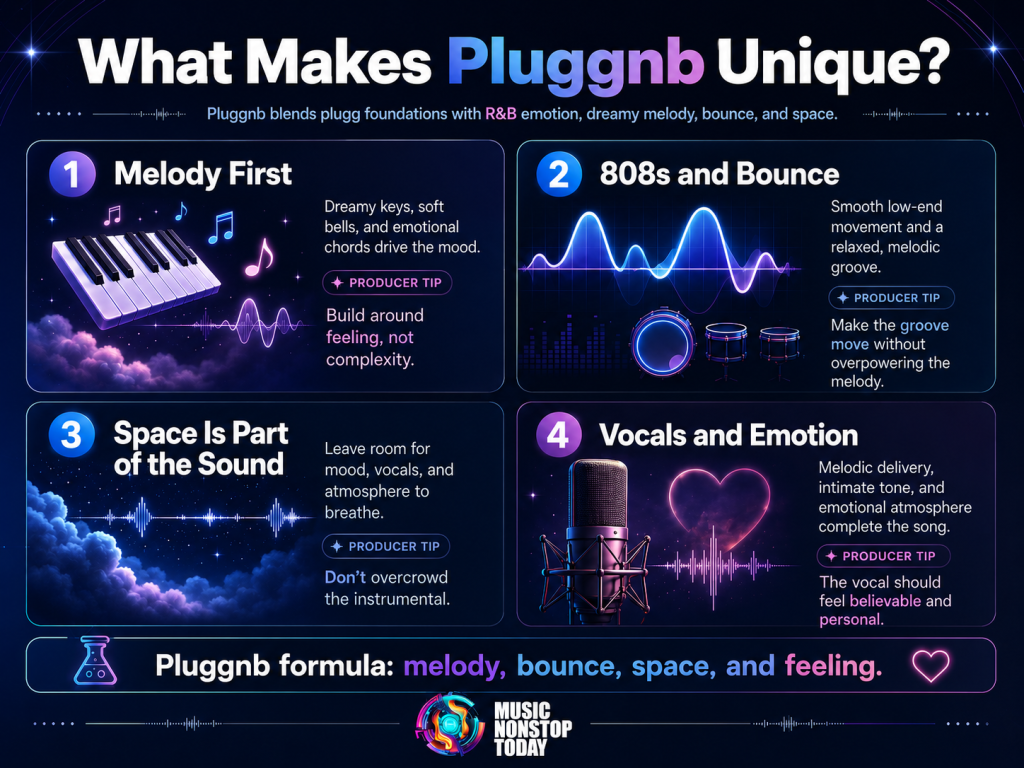
Melody comes first because pluggnb is emotionally driven. The main loop needs to carry the mood before the drums even enter. It can be a soft-key progression, a bell melody, a hazy synth layer, a reversed texture, or a simple chord progression that feels intimate.
Bounce comes from the relationship between drums and 808s. Pluggnb does not always need aggressive drums, but the rhythm still has to move. A beat can be minimal and still have pocket.
Space is part of the sound. If the instrumental is overcrowded, the vocal has nowhere to live. If every frequency is filled, the emotional atmosphere disappears.
Feeling is the final test. A pluggnb beat can be technically correct and still forgettable. The question isn’t just, “Does this sound like pluggnb?” The question is, “Does this make somebody want to write something personal?”
Use that lens when choosing tools.
Melody Sources: Keys, Bells, Pads, Plucks, and Emotional Chords
The most important tool category for pluggnb producers is the melody source.
You need sounds that can carry emotion without sounding too polished, too cinematic, or too generic. Pluggnb melodies often live in a dreamy middle ground: soft enough for vocals, bright enough to catch attention, and simple enough to loop without becoming annoying.
Good sound categories include:
- soft electric pianos
- bell-like keys
- dreamy plucks
- airy pads
- glassy synth leads
- detuned digital keys
- emotional chord textures
- retro organs or vintage keys when used tastefully
This is where Native Instruments (NI) makes sense as an affiliate target. Kontakt instruments, synths, keys, and production bundles can give producers a wide palette for melody building. The important thing is not to tell producers that one NI product “makes pluggnb.” It does not. A stronger argument is that a broad instrument library helps producers find the right emotional color faster.
Output can also be relevant here, especially for producers looking for motion, texture, and modern melodic inspiration. Output tools often appeal to producers who want movement and atmosphere rather than plain static presets.
Advice: do not buy another instrument just because you are stuck. First, try writing a better chord progression with what you already own. A strong two-chord loop with the right sound can beat a thousand-dollar plugin chain with no feeling.
Sample Libraries and Loops: Useful, but Dangerous
Pluggnb spreads heavily through loops, sample packs, and type-beat culture. That makes sample libraries important, and at the same time risky.
A good loop can spark a beat quickly. It can give you a chord progression, texture, or emotional direction that would take longer to build from scratch. For producers trying to upload consistently, sample libraries can be part of a real workflow.
But loops can also make producers lazy.
If you drag in the same kind of soft bell progression everyone else is using, add a stock 808, and upload it as a “pluggnb type beat,” the result may technically fit the genre but still sound anonymous. The producer’s job is to flip the idea, change the rhythm, add a counter-melody, remove unnecessary layers, chop the loop, reverse it, resample it, or build around it in a way that gives the beat identity.
Splice is one of the most relevant affiliate targets for this cluster because pluggnb is so connected to sample and producer culture. For this article, the strongest angle is not “buy samples.” The stronger angle is: “Use samples as starting points, not shortcuts.”
Loopmasters is another logical option for monetizing sample packs. It can work especially well in articles about beatmaking, sample selection, and producer workflow.
A useful rule: if the loop already sounds like a finished beat, do more to make it yours. If the loop leaves space for you to add identity, it may be a better starting point.
808s and Bass Tools: The Low End Should Move, Not Bully the Beat
Pluggnb 808s should support the mood. They can slide, glide, bend, and answer the melody, but they should not flatten the emotional space.
The best low-end decisions are usually musical decisions. Is the 808 following the root notes too obviously? Does the slide create tension? Does the bass leave enough room for the kick? Does the low end feel controlled on small speakers, headphones, and car systems?
For many producers, the most useful “808 tool” is not a fancy plugin. It is a well-tuned 808 sample, good pitch control, clean envelope shaping, and careful mixing. If the 808 is out of key, too long, too distorted, or fighting the kick, no plugin will magically fix the beat.
Tools that may help include:
- tuned 808 sample packs
- saturation plugins
- EQ
- sidechain tools
- bass enhancers used carefully
- clipping/limiting tools for controlled loudness
Waves can be relevant in this area because the brand has many mixing and dynamics plugins. The recommendation should be careful: do not suggest producers need a huge bundle. A small set of good EQ, compression, saturation, and limiting tools is enough for many home producers.
Plugin Boutique is also a strong affiliate candidate because it sells a wide range of plugins from multiple developers. For Music Nonstop Today, it may be especially useful as a general marketplace link when recommending categories rather than a single brand.
Most weak 808s are not weak because the producer lacks a premium plugin. They are weak because the notes, envelope, tuning, or relationship with the kick are not right.
Drum Sounds: Keep the Pocket Relaxed but Alive
Pluggnb drums do not need to be complicated. In many cases, simple drums work better because they leave room for melody and vocals.
But simple is not the same as boring.
A relaxed groove still needs movement. Hi-hats can create bounce without becoming busy. Claps and snares can sit slightly behind or ahead, depending on the feel. Open hats and percs can create small moments of lift. The drums should frame the mood, not compete with it.
Useful drum resources include:
- clean trap drum kits
- softer snares and claps
- tight hi-hats
- warm kicks
- subtle percussion
- 808 one-shots that are already tuned well
Sample platforms such as Splice and Loopmasters make sense here, but again, the point is taste. A producer can have thousands of drums and still choose the wrong snare.
The best drum choice is usually the one that makes the melody feel more alive.
Vocal Tools: Pluggnb Needs Emotion, Not Just Auto-Tune
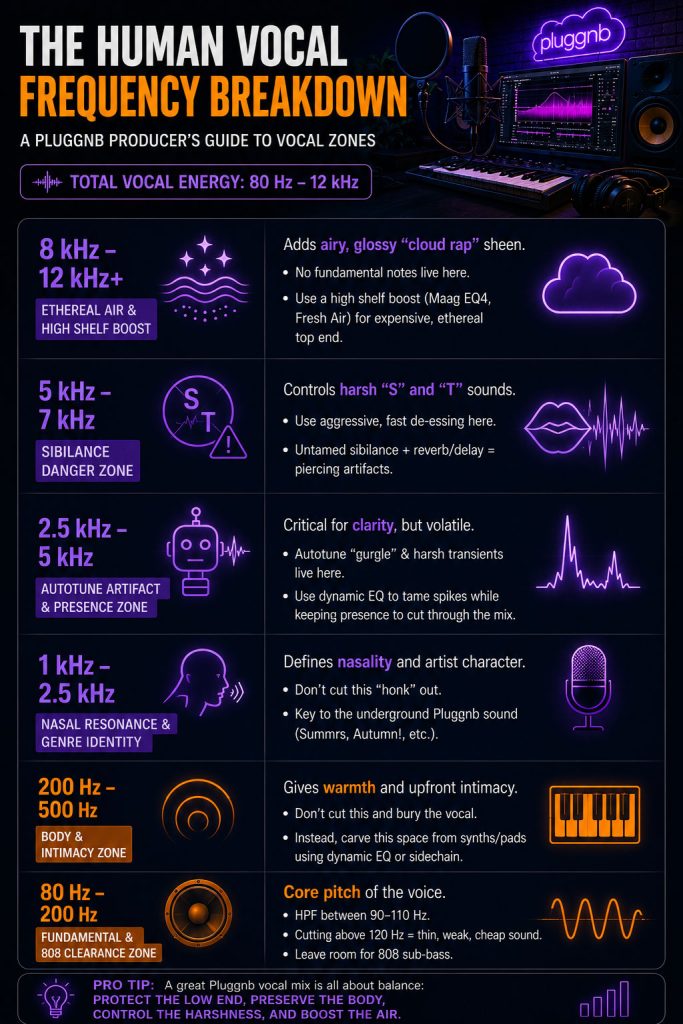
The Human Vocal – Breakdown by Frequency Zones
The human vocal range generally lives between 80 Hz and 1.1 kHz for fundamental frequencies, but its total acoustic energy—including breath, harmonics, and intelligibility—stretches from 80 Hz up to 12 kHz.
- 80 Hz – 200 Hz (The Fundamental & 808 Clearance Zone): This is the core pitch of the artist’s voice. To prevent muddy clashing with heavy, sliding 808 sub-bass lines, a high-pass filter is standardly set between 90 Hz and 110 Hz. Cutting any higher than 120 Hz is a mistake; it strips the fundamental chest resonance and makes the artist sound thin and cheap.
- 200 Hz – 500 Hz (The Body & Intimacy Zone): This zone gives Pluggnb vocals their warmth and upfront intimacy. A common amateur mistake is cutting this area to avoid clashing with lush Rhodes chords or digital synth pads. Doing so buries the vocal. In a real plugg mix, you keep this warmth in the vocal and instead carve this frequency pocket out of the synth melodies using a dynamic EQ or sidechain compression.
- 1 kHz – 2.5 kHz (The Nasal Resonance & Genre Identity): This range dictates vocal nasality and distinct artistic character. While traditional audio engineers often cut here to remove “honkiness,” Pluggnb heavily relies on this specific nasal resonance (the signature style of artists like Summrs or Autumn!). Leave this zone largely intact to preserve the raw, underground vocal identity.
- 2.5 kHz – 5 kHz (The Autotune Artifact & Presence Zone): This is the most critical area for vocal clarity, but it is also highly volatile. Because Pluggnb relies on maximum Autotune speed and heavy compression, the digital “gurgle” and harsh robotic transients show up heavily here. Use a dynamic EQ to tame harsh digital spikes in this zone while keeping enough overall energy so the vocal cuts through fast-paced hi-hat and rimshot patterns.
- 5 kHz – 7 kHz (The Sibilance Danger Zone): This is the harsh “S” and “T” region. Pluggnb vocal chains require aggressive, fast-acting de-essing here. Because plugg mixes use extreme amounts of high-frequency delay and ambient reverb, any untamed sibilance in this zone will trigger massive, piercing artifacts that ruin the spatial mix.
- 8 kHz – 12 kHz+ (The Ethereal Air & High Shelf Boost): This is the holy grail zone for the modern Pluggnb aesthetic. To achieve that expensive, glossy, breathy “cloud rap” sheen that sits perfectly over ambient beats, producers apply a heavy high-shelf boost in this range using tools like Maag EQ4 or Fresh Air. Because there are no musical fundamental notes up here, you can boost this aggressively to get that airy contrast against the heavy low-end bass.
If the article is about beats only, vocals may seem secondary. But pluggnb producers should think about vocals early because the beat is often built to invite melodic delivery.
A finished pluggnb song usually depends on intimacy. The vocal can be polished, raw, sad, bright, numb, romantic, or vulnerable, but it has to feel believable. Pitch correction and vocal effects can help create the texture, but they cannot replace performance.
Useful vocal tool categories include:
- pitch correction
- EQ
- compression
- de-essing
- reverb
- delay
- vocal widening
- saturation
- vocal cleanup tools
iZotope is highly relevant here. Nectar, Ozone, Neutron, RX, and related tools can support vocal production, mixing, mastering, and cleanup. The honest framing is that iZotope tools can help producers finish and polish tracks, especially if they are doing everything themselves. They will not make a lifeless vocal emotional, but they can help a good vocal sit in the mix.
LANDR can also fit this part of the funnel, especially for mastering and release preparation. It may be more relevant to finished songs than beat creation.
Mixing Tools: Space Is the Sound
Pluggnb mixing is not only about loudness. We’ve mentioned it a few times, but it is about space.
The melody needs to feel wide or dreamy without swallowing the vocal. The 808 needs weight without mud. The drums need presence without turning the beat into a hard trap record. The vocal needs intimacy without sounding buried. Reverb and delay need atmosphere without washing out the center.
Useful mixing tools include:
- EQ for carving space
- compression for control
- saturation for warmth
- reverb for atmosphere
- delay for movement
- stereo tools for width
- limiters for final loudness
But the most important mix decision is the arrangement. If five melodic layers are fighting each other, EQ will only do so much. Sometimes the best mix move is muting a sound.
This is where many pluggnb beats set themselves apart. The amateur version fills every gap. The better version leaves air.
A clean mix does not mean sterile. Pluggnb can be dreamy, hazy, and emotional. But haze should feel intentional, not accidental.
Release and Distribution: When the Beat Becomes a Song
For producers who also release songs, collaborate with artists, or build a public catalog, distribution becomes part of the workflow.
This is where DistroKid (🛒) fits naturally. It is not a beatmaking tool, but it matters when a pluggnb song is finished and ready for Spotify, Apple Music, TikTok, YouTube Music, and other platforms.
Release your pluggnb song or a beat to streaming platforms with a 20% discount from our affiliate link (🛒). At the same time, buying DistroKid through our link supports our work.
DistroKid also makes sense for future articles in this cluster, especially:
- How to submit a Pluggnb song for review
- How to release a pluggnb single
- How producers can turn beats into artist-facing releases
- How to build a searchable producer catalog
Brutally honest advice: distribution does not equal promotion. Uploading the song is only the beginning. Producers still need visuals, short-form content, collaborations, metadata, artwork, editorial content, and a reason for listeners to care.
That is where a review, an interview, or a third-party article can help create context for the release.
Pluggnb Producer Toolkit: A Practical Setup
A producer does not need every tool on the market. A focused toolkit is better than a bloated plugin folder.
Here is a practical pluggnb setup:
- Melody source:
A strong keys/synth instrument or sample library for soft bells, pads, plucks, and emotional chords.
Recommended tools: Native Instruments, Output, Splice - Samples and loops:
A royalty-free sample source for melodic ideas, drums, textures, and 808s.
Recommended tools: Splice, Loopmasters - 808 and drum control:
Good one-shots, EQ, saturation, clipping, and basic dynamics tools.
Recommended tools: Plugin Boutique, Waves - Vocal polish:
Pitch correction, EQ, compression, de-essing, reverb, delay, and vocal cleanup.
Recommended tools: iZotope, Waves, Plugin Boutique - Mastering and release:
A mastering/release workflow for finished songs.
Recommended tools: iZotope, LANDR, DistroKid
But pelase remember, the best setup is not the most expensive one. The best setup is the one that helps you finish beats and songs that actually feel like you.
What Not to Buy Yet
Here is the part many affiliate articles avoid saying: you probably do not need everything.
If you are new to pluggnb, do not buy five synths before you understand chord movement. Do not buy a vocal bundle before you know how to record a clean vocal. Do not buy ten 808 packs before learning how to tune and arrange the bass. Do not buy a mastering tool and expect it to fix an overcrowded mix.
Spend money where it solves a real bottleneck. For instance:
- If your melodies feel weak, invest in better instruments or learn harmony.
- If your beats sound generic, study the arrangement and sound selection.
- If your low end is messy, learn tuning, envelopes, and gain staging.
- If your songs feel unfinished, look at vocal production and mixing.
- If your music is finished but still invisible, consider your release strategy, branding, and editorial coverage.
Tools should support your taste. They should not replace it.
To Remember: The Tool Is Not the Identity
Pluggnb is a producer-friendly sound because it rewards emotion, melody, space, and bounce. But that also means it is easy to imitate badly.
A young producer can download a sample pack, use a bell loop, add a sliding 808, upload a “pluggnb type beat,” and technically be in the lane. The harder job is building an identity inside the lane.
That identity comes from choices.
- The melody is simple.
- The layer you mute.
- The 808 slide you do not overuse.
- The vocal pocket you leave open.
- The texture that makes your beat recognizable.
- The restraint that lets the emotion breathe.
Good tools help. Good taste matters more.


