



Skopje’s independent artists can struggle to afford the city’s public venues, cultural worker Ivana Dragšić told the opening panel of the PIN Music Conference on November 26. As North Macedonia’s capital prepares to be a European Capital of Culture in 2028, she wants the people who already put on festivals and performances to help decide what the city commissions.
Dragšić had initially opposed the bid. She wanted the city to examine its cultural policy and the divisions left by Skopje 2014. Speaking at the 13th PIN Music Conference, she described one reason for greater confidence. Independent cultural workers now had people at the Skopje 2028 foundation they could talk to. The question was how much say they would have.
How much room will artists have?
Zvonko Naumoski, representing Skopje 2028, used furniture to explain the difficulty of commissioning art with public money. When buying furniture, a public body can specify exactly what it wants. If it describes a cultural project in the same detail, what decisions are left for the artist?
Naumoski said the foundation was developing a way to invite proposals around broad program ideas. Artists could then decide how to interpret them. The program was still in draft when he spoke.
For Dragšić, the independent scene already has something to offer at that early stage. Skopje’s cultural organizations have built partnerships across Europe on limited resources. They bring experience in finding collaborators and trying out ideas that local institutions can draw on.
How other cities opened their programs
In Nova Gorica, Slovenia, and neighboring Gorizia, Italy, groups that had missed out on the original 2025 bid got another chance. Romina Kocina, who worked on the cross-border program, said open calls allowed more groups on both sides of the border to propose projects. Some partners kept working together after their first grant. For Kocina, those relationships were part of what the title left behind.
Liepāja, Latvia, involved independent artists earlier. Baiba Bartkeviča said artists, cultural institutions and nonprofits helped write the city’s bid for 2027. Luca Jacob offered a parallel from WOMEX, the traveling music showcase. A local producer knows which musicians and scenes a visiting festival might overlook. That knowledge can shape who gets heard by promoters, labels and venues.
What would success look like after 2028?
An audience member brought the discussion back to Skopje by asking what projects the cities planned for Roma residents. Naumoski said he wanted Roma people to help create Skopje’s program. Who gets to develop those projects will be one way to judge how that intention takes shape.
Dragšić offered a test that will still matter in 2029. Independent groups already know how to piece together grants and keep festivals running. Once the title year ends, will those organizers be able to afford a venue for the next edition?
Panel details
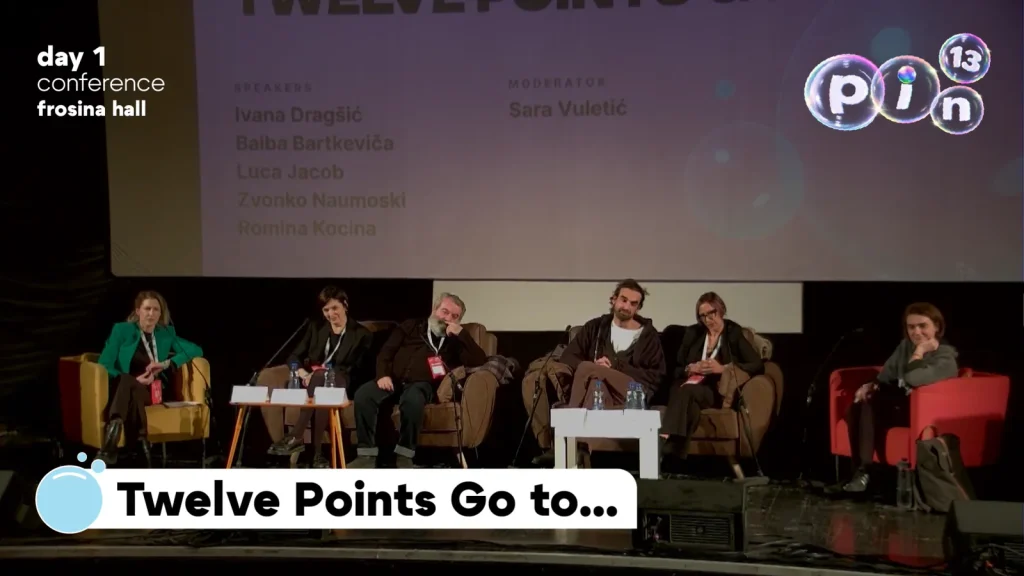
Twelve Points Go to… opened the conference on November 26, 2026, at Frosina Cinema in Skopje’s Youth Cultural Center (MKC). The session’s subtitle was European Capital of Culture 2028: From Bid Book to Implementation. Sara Vuletić, former program director of Novi Sad 2022, moderated.
| Panelist | Affiliation or role |
|---|---|
| Ivana Dragšić | Independent cultural worker, North Macedonia |
| Baiba Bartkeviča | Liepāja 2027, Latvia |
| Luca Jacob | Piranha Arts / WOMEX, Germany |
| Zvonko Naumoski | Skopje 2028, North Macedonia |
| Romina Kocina | EGTC GO / Nova Gorica–Gorizia 2025, Slovenia and Italy |
You can watch PIN’s panel recording here:


